 By Femke Irik · · 5 min read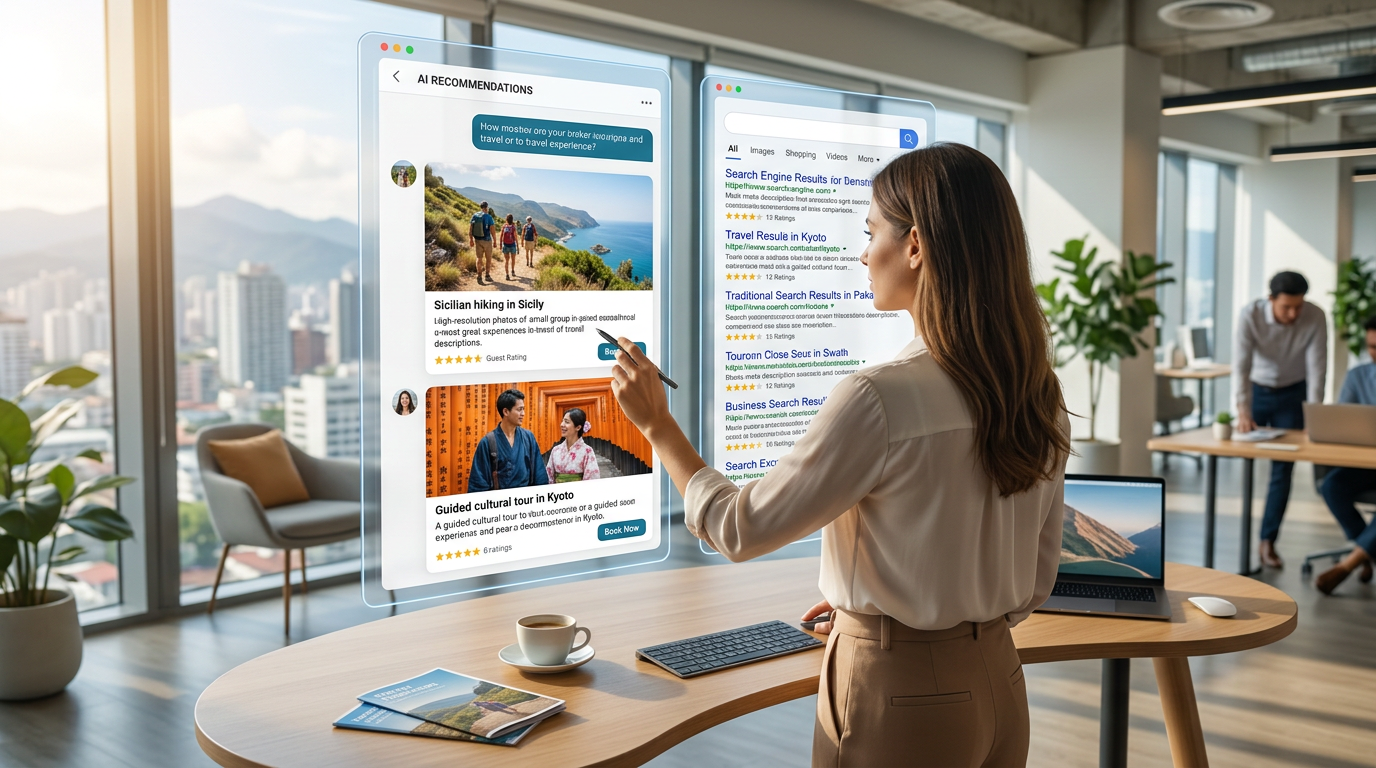
How to Get Your Tours Recommended by AI Assistants
Travelers are changing how they plan trips. Instead of just searching Google for "tours in Rome," they are asking AI assistants complex questions like: "Find me a family-friendly boat tour in Split that allows strollers and has a bathroom."
To stay visible, you need to move beyond traditional SEO and focus on AI Search Optimization (ASO). This means making sure an AI can "read" and understand your business rules and logistics.
The Shift: From Keywords to Questions
Traditional search engines look for keywords. AI assistants look for answers. If a traveler asks for a tour that is wheelchair accessible, but you only show a wheelchair icon in an image, the AI might not realize you offer it.
The Problem: AI models (LLMs) browse the web to find the best match for a user’s specific needs. If your website doesn't clearly state your policies or amenities in plain text, the AI will skip you and recommend a competitor who does.
The Solution: Stop using "thin" content. Every tour page should have deep, factual details. Add detailed FAQs, precise meeting point descriptions, and clear cancellation policies. Using tools like Smart Chat can help you see what guests are asking so you can add those answers to your website.
Mistakes to Avoid: Do not hide important details inside images or PDF brochures. AI models primarily "read" text. If your meeting point is only a red dot on a JPEG map, the AI cannot tell a traveler how to find you.
How to implement it today:
- Find 3 tours and check for "hidden" info (like stroller access or bathroom stops).
- Write those details out in a simple bulleted list on the product page.
- Make sure your Google Business Profile has these same details updated.
The Intelligence Discovery Framework
Use this framework to make sure your data reaches the traveler’s AI screen.
| Stage | What it means | Example for Operators |
|---|---|---|
| 1. Data Accessibility | Bots can read your text easily. | Listing "Meeting Point: North Gate" as text, not just a map image. |
| 2. Trusted Distribution | You are on sites the AI trusts. | Having a high-rated profile on GetYourGuide. |
| 3. Specific Details | You share niche info. | Explicitly mentioning "infant seats available" for van tours. |
| 4. Verification | Recent proof of your quality. | Getting reviews that mention the specific "friendly guides" the AI promised. |
| 5. Easy Booking | The guest can book instantly. | Using Smart Booking by TravelCS for a fast checkout. |
The Importance of Live Data
AI assistants hate giving out-of-date information. If a traveler asks, "Is there a ghost tour available tonight?", the AI will look for "live" data it can verify.
Why it matters: AI tools prioritize high-authority sites with live connections—like GetYourGuide—because they know the availability is real. Instant booking capabilities may make an operator easier for AI tools to recommend than "on-request" email forms.
What to do: Ensure your calendars are synced. TravelCS provides a live, API-certified integration with GetYourGuide to keep your availability accurate. Today TravelCS is API-certified with GetYourGuide, and also connects Gmail, Outlook, WhatsApp Business and Stripe. We don't confirm any other booking or OTA integration, and we don't publish delivery dates — check the TravelCS integrations page for the current live list.
TravelCS Insight: The "Zero-Click" Reality
Many travelers leave a site because they can't find a quick answer. In AI search, if the AI recommends you but can't answer a follow-up like "Is hotel pickup included?", the traveler will move to the next suggestion. Operators who list these "micro-details" (like specific pickup zones) usually see higher engagement because they remove doubt for the traveler.
Writing for Natural Language
People talk to AI in full sentences. To show up in these results, your content needs to answer these specific needs.
The Goal: Describe who the tour is for and who it isn't for. Instead of just writing "Best NYC Tour," explain that it is "Perfect for seniors who want a quiet morning walk with no stairs."
How to implement it today:
- Check your Smart Inbox for the questions guests ask most often.
- Add an "Operational Details" section to every tour page.
- Include a simple table of "What's Included" and "What to Bring."
Handling Multilingual Search
AI is great at translation. A traveler can ask in Spanish for a tour in Tokyo, and the AI will translate your English website to give them an answer.
Accuracy is key: You don't need a perfectly translated website for every language, but you do need very clear English text that the AI can "conceptually map." For direct guest messages, Smart Chat allows you to reply in the guest's native language instantly, keeping their trust.